AI caption tips: writing captions that don't sound like AI
How to brief an AI so captions keep a brand's voice: prompts that work, past posts as examples, banned words, the AI tells to edit out, per-network rewrites.

AI does not write badly. It writes the average, and after a few years of AI-assisted posts, readers know exactly what the average sounds like.
Researchers have measured the same effect in a field far from social media. Looking at more than 15 million biomedical abstracts, one team found that in 2024 the word "delves" appeared about 28 times more often than the pre-ChatGPT trend predicted, followed by "underscores" and "showcasing" (Kobak et al., Science Advances, 2025). Your client's followers have their own version of that radar, and it goes off at the first "Ever wondered...?"
The fix is not a cleverer adjective in the prompt. It is better input before the AI writes, and a sharper edit after.
Why AI captions all sound the same
A language model writes the most plausible words given what you give it. Hand it a product name and "make it engaging", and plausible means generic: an opening question, three benefits, an exclamation mark, a block of hashtags.
Everything that makes a brand recognisable has to come from you: how the owner talks, and the details only they would mention. When that is missing, the AI fills the gap with the most common version of every sentence.
Brief the AI like a new copywriter
Say you run the Instagram account of a neighbourhood bakery that is launching a new loaf. Here is the prompt most people write:
Write an engaging Instagram caption for our new sourdough loaf.
And here is one that gives the AI something to work with:
You are writing an Instagram caption for Forno Rossi, a family bakery
in a residential neighbourhood.

Audience: locals aged 30-60 who walk past the shop on the way to work.
Goal: get pre-orders for the new rye sourdough, available Saturday.
Facts: 30% rye, 36-hour fermentation, 1 kg loaf. 40 loaves only.
Pre-order by DM before Thursday 18:00.

Voice: warm, plain, a little dry. Short sentences. Sounds like Paola,
the owner, talking to a regular at the counter.
Never use: artisanal, elevate, indulge, journey, passion, "not just",
exclamation marks.
Format: under 600 characters. The first line must work on its own and
stay under 80 characters. One emoji at most. Three hashtags at the end.

Three past captions the client liked are below. Match their tone,
not their topics.
1. [paste]
2. [paste]
3. [paste]

Write three different options.
What each part does
Context and audience tell the model who is speaking to whom. "Locals on the way to work" produces different sentences from "food lovers".
Facts are the part people skip, and the reason so many captions say nothing. If you do not supply the details, the AI will write around them with vague praise or, worse, invent some. Check every fact in the output against your brief.
Voice as "this, not that" is easier for a model to follow than a list of adjectives. "Warm, not cute" draws a line; "friendly and professional" does not.
A banned list removes the words that make a caption sound machine-made before you have to edit them out. Keep one per client and add to it every time you cut something.
Format and rhythm stop the default shape. Asking for short sentences and a first line that works alone matters more on social than almost any other instruction, because the first line is often all anyone sees.
Examples do more than any description of tone. OpenAI's own prompting guide recommends steering a model with examples and suggests showing "a diverse range of possible inputs with the desired outputs" (OpenAI prompt engineering guide). For captions, that means three past posts on different topics, all in the voice you want.
Asking for options gives you raw material. The best caption is often the first line of option two with the ending of option three.
Keep a voice block for each client
Most of that prompt never changes. Save the voice, the banned list and the example posts as a block for each client, then add only the goal and the facts for each new post. It takes ten minutes to set up and saves you from rewriting the same instructions every day.
The tells to edit out
Wikipedia's volunteer editors keep a field guide to recognising AI-written text (Signs of AI writing). It is written for encyclopedia articles, but most of it applies to captions, and it makes a fair point: these signs are clues, not proof. People wrote this way before AI did. The problem is not who wrote it; it is that these patterns now read as filler.
Check every AI draft for:
- Stock vocabulary: delve, elevate, unlock, unleash, seamless, vibrant, tapestry, testament, "in today's fast-paced world".
- The contrast formula: "It's not just bread, it's a ritual." Once is fine. In every caption, it is a signature.
- Everything in threes: "Fresh, local and made with love."
- The rhetorical opener: "Ever wondered what makes the perfect loaf?"
- The moral at the end: "Because great bread is about more than flour."
- "Whether you're a... or a...": the sentence that tries to speak to everyone and reaches no one.
- Emoji used as bullet points, and hashtags piled into a paragraph of their own.
- Punctuation habits: a dash in every sentence, a colon before every reveal.
- Inflated stakes: a loaf of bread is not "a celebration of craftsmanship".
Then read the caption aloud. If the owner would not say it at the counter, rewrite it until they would.
Before and after
The kind of draft you get from the one-line prompt:
Ever wondered what makes the perfect loaf? [bread emoji] Our new rye sourdough isn't just bread, it's a celebration of tradition, patience and passion. Crafted with care over 36 hours, it's a testament to our artisanal roots. Whether you're a sourdough lover or a curious foodie, this is one loaf you won't want to miss. [sparkles emoji] #bread #sourdough #artisan #bakery #foodie #handmade #local #fresh
After the brief and an edit:
New on Saturday: rye sourdough.
30% rye, 36 hours of fermentation. Paola has been testing it since August and has finally stopped changing the recipe.
We're baking 40 loaves. Send us a message by Thursday at 18:00 and we'll put one aside.
#sourdough #ryebread #neighbourhoodbakery
Same facts, plus one detail that came from asking Paola, not from the AI. The second version has a person behind it and a reason to message before Thursday. It also respects the five-hashtag cap Instagram began rolling out in December 2025 (Social Media Today), which the first draft would break. We cover what works instead in Instagram's hashtag limit in 2026.
Rewrite for each network instead of pasting
The same news needs a different caption on each network, and not only because of length. LinkedIn allows up to 3,000 characters in a post (LinkedIn Help), while a Threads post stops at 500, with longer text going into an attachment of up to 10,000 characters (Meta). The caption and media limits for Instagram, Facebook, LinkedIn, TikTok, X, Threads and Pinterest are on one page in our free social media limits reference.
Give the AI a job for each network, not just a character count:
- Instagram: the caption supports the image. Lead with the news, put details after the first line.
- Threads: one idea, conversational, and if you end with a question, make it one the brand actually wants answered.
- LinkedIn: the story behind the post. For the bakery, that is the supplier, the months of testing, the new hire who runs the early shift.
- TikTok: the video's first seconds do the work. Keep the caption short, with the plain words someone would type to find this video.
- X: one sharp line, with the link or the detail that matters.
A rewrite prompt can be this short:
Rewrite this caption for Threads. Under 300 characters, conversational,
no hashtags. End with one real question Paola would like regulars to
answer. Keep every fact exactly as it is.
That last sentence matters. Rewrites are where invented details creep in.
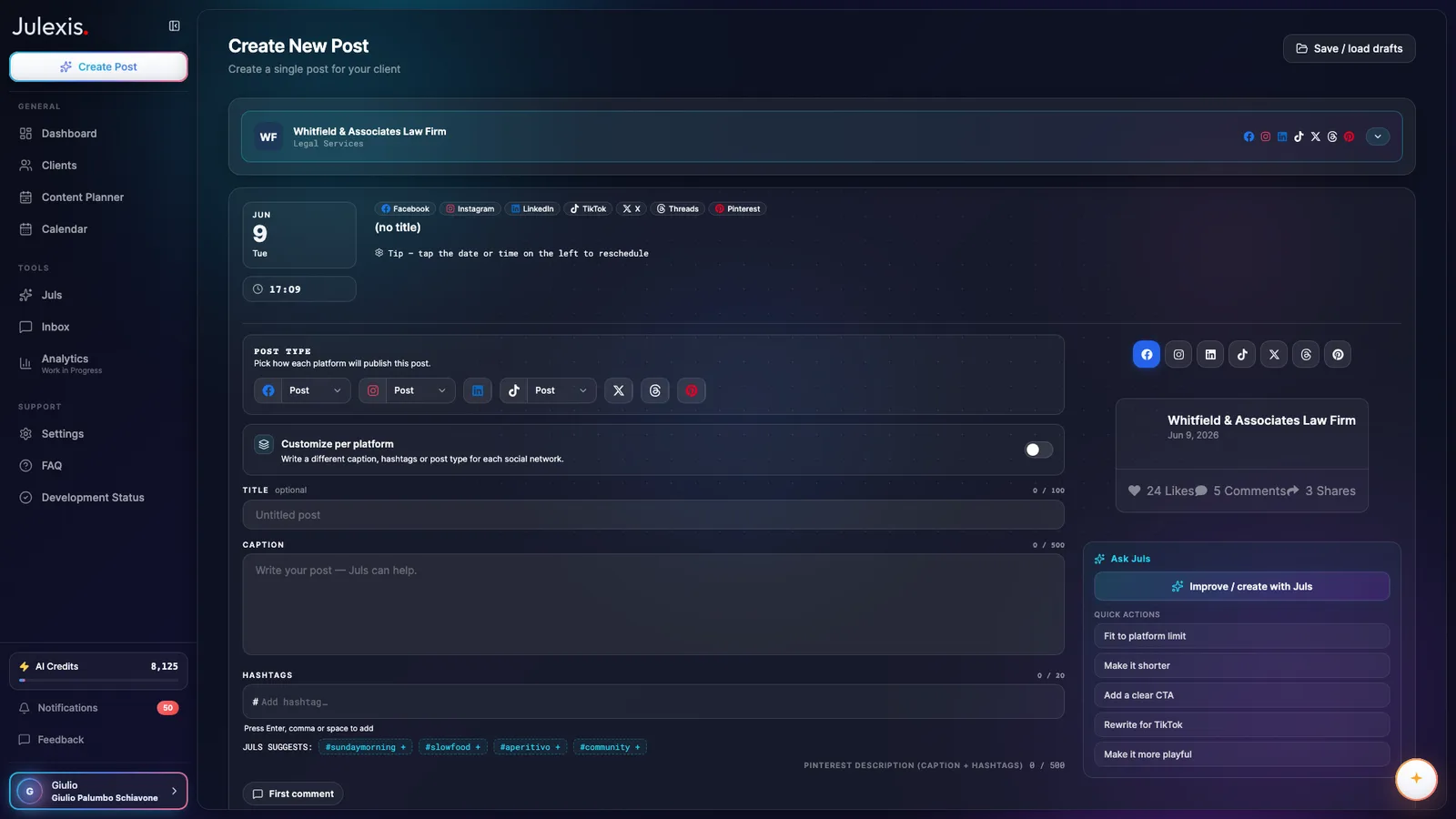 A post editor with an AI panel on the right offering quick actions such as Fit to platform limit, Make it shorter and Rewrite for TikTok.
In Julexis, AI writing comes with credits included in every plan, so there is no API key to set up. Quick actions in the post editor fit a caption to a network's limit, make it shorter or rewrite it for TikTok, and each client's brief, built from their documents or their website, keeps the AI on that client's voice. See the features.
Should you disclose AI-written captions?
Whether AI-assisted content needs a label depends on the platform, the format and where your audience is, and the rules have been moving. We go through what applies today in AI labels on social media in 2026.
Two habits are worth keeping whatever the rules say. Tell clients in your contract or proposal that you use AI tools for drafting, so it is never a surprise. And never let AI write what must be true: reviews, testimonials, quotes, statistics, or anything a customer could rely on.
Key takeaways
- AI writes the average. Your job is to supply what is not average: facts, audience, voice and examples.
- Give the AI three past posts the client liked, a "this, not that" voice and a banned list, and save them as a block per client.
- Edit for the tells: stock words, "not just X, it's Y", everything in threes, rhetorical openers and morals at the end.
- Rewrite for each network with a job in mind, and tell the AI to keep every fact unchanged.
- Never let AI write what must be true, and be open with clients about how you use it.
Cover image generated with AI.